

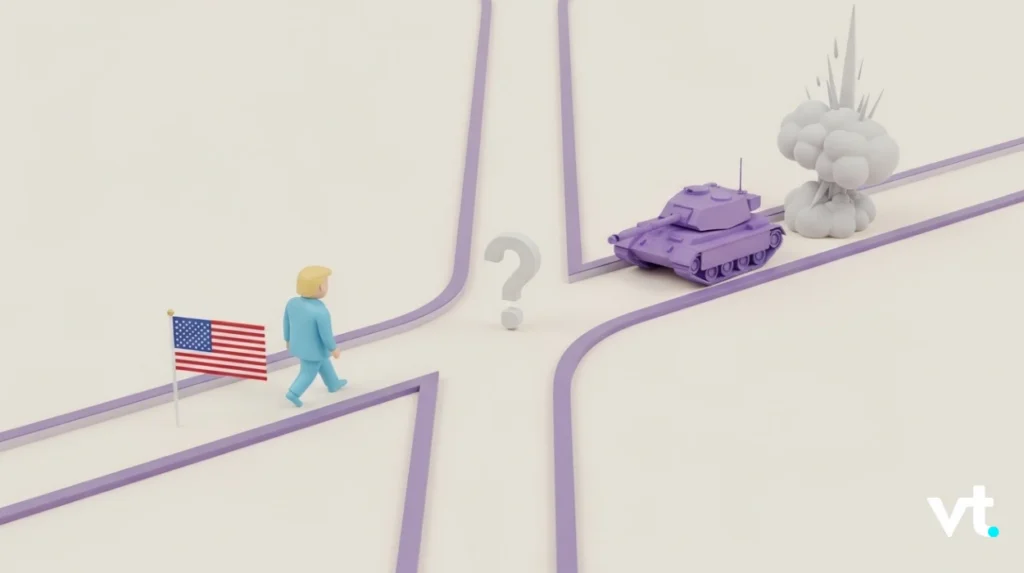
On the evening of 1 April 2026, President Donald Trump addressed the nation from the White House Cross Hall in what was billed as an “important update” on the war in Iran. It was his first formal primetime address since Operation Epic Fury began on 28 February and markets were watching closely for signs of clarity.
Instead, the 20-minute speech left investors with more uncertainty. Trump praised battlefield progress, extended the war’s timeline, threatened to bomb Iran’s power grid, and left the Strait of Hormuz question wide open. Oil jumped nearly 4% within minutes of him leaving the podium.
Key takeaways
- Trump’s 1st April speech was his first formal address since Operation Epic Fury began on 28 February
- Trump signalled that the US would strike Iran “extremely hard” over the next two to three weeks, lifting Brent crude above $104 and reversing the market’s pre-speech optimism
- The Strait of Hormuz remains severely disrupted, placing at risk a corridor that carries roughly one-fifth of global oil supply, with no clear US plan to restore normal shipping conditions
- Bank of America economists expect oil to remain near $100 per barrel through the rest of 2026, alongside slower growth and firmer inflation
The War at a Glance: Five Weeks In
The US–Israeli military campaign against Iran has now entered its fifth week. What began as a targeted strike operation focused on Iran’s missile programme, destroying its navy, and eliminating its path to a nuclear weapon has evolved into a broad regional conflict with significant humanitarian, economic, and diplomatic fallout.
- 13 US service members killed since the operation began on 28 February 2026
- 1,700+ Iranian casualties reported, according to Iranian state sources
- 400+ targets struck by Israeli and US forces in the 48 hours leading up to 1 April
- $104.44—Brent crude price on 1 April, up 3.24% in the hours following Trump’s speech
The fallout is no longer limited to Iran itself. Attacks on vessels and the growing security risk in the Strait of Hormuz have severely disrupted commercial traffic through one of the world’s most important energy chokepoints. Israeli strikes have extended to Beirut, while Yemen’s Houthi rebels have launched missile attacks on Israel and threatened further escalation. The reported kidnapping of a US journalist in Baghdad has added to concerns that the conflict is spreading well beyond its original theatre.
Why Trump Speech Mattered to Markets
For the past five weeks, traders and analysts have been trying to make sense of a steady stream of conflicting signals from Washington. Treasury Secretary Scott Bessent said the US would “retake control of the straits.” Trump, by contrast, suggested other nations may need to “fend for themselves.”
He also claimed that Iran’s president had requested a ceasefire, a statement Iran dismissed as “false and baseless.” At other points, Trump threatened to strike Iran’s oil infrastructure, before later saying the US was “not going to have anything to do with” what happens in the strait.
Markets had rallied strongly in the two days before the speech on growing optimism the war might end soon. That rally unwound fast once Trump’s speech content became clear.
As the first formal primetime presidential address of the conflict, the speech carried more weight than a passing remark to reporters. It signalled a deliberate effort to project control and shape both public perception and market expectations.
What Trump Was Trying to Achieve Politically
Polling consistently shows American patience wearing thin. The war has pushed average US petrol prices above $4 per gallon. Bank of America economists forecast slower growth, higher inflation, and oil at $100 per barrel through the rest of 2026. Trump enters midterm-election territory with an increasingly unpopular war on his hands.
The speech’s political architecture was clear:
- Restate the four objectives of Operation Epic Fury as achieved or near-achieved — destroying Iran’s missiles, navy, terror-proxy network, and nuclear capability
- Compare the conflict’s brevity favourably to past US wars (WW1, WW2, Korea, Vietnam, Iraq)
- Reassure the public the war is “nearing completion” and will end “very shortly”
- Project strength by threatening to hit Iran’s electricity grid and oil infrastructure if no deal is struck within two to three weeks
White House officials later said they were pleased with the address. But the reaction was far from uniform. Former Representative Marjorie Taylor Greene offered a much harsher verdict, saying the speech was all about war and did nothing to address the rising cost of living.
The Mixed Signal Problem — and Why It’s the Real Risk
The central challenge for markets is that the White House has been sending contradictory signals almost daily.
The speech was supposed to bring clarity. Instead, it added another layer of uncertainty. That leaves markets trying to price not one clear outcome, but several competing ones.
Three near-term scenarios now matter most:
| Scenario | Trigger | Market implication | Probability signal |
| Near-term ceasefire or deal | Iran reopens Hormuz; back-channel talks succeed | Oil sharp selloff; risk-on rally; gold retreats | Low — Iran denies requesting ceasefire |
| Continued military action (2–3 weeks) | No deal; US hits power grid and oil targets as threatened | Oil above $110; inflation expectations rise; equities slide | High — explicitly telegraphed in speech |
| Escalation beyond Iran | Houthi or Hezbollah escalation; China–Pakistan dynamics; NATO fracture | Safe-haven surge; gold, yen, USD bid; broad risk-off | Rising — conflict has already spread to Beirut and Kuwait |
Trump‘s statement that other countries must “fend for themselves” on the Strait of Hormuz is particularly significant. It suggests the US could step back while the Strait of Hormuz remains disrupted. For markets, that would still be a problem because even if US involvement eases, the supply risk would not go away.
How the War Is Already Affecting Fuel, Trade, and Sentiment
Energy
Brent crude reached $104.44 per barrel on 1 April, rising more than 3% on the day of the speech. US crude traded at $102.36. Countries in Asia that rely heavily on Middle Eastern oil could face fuel pressure in the weeks ahead, with Europe also exposed if disruption continues. The supply risk has already become more visible, with reports of a Kuwaiti oil tanker being hit by Iranian drones near Dubai and a QatarEnergy-chartered tanker struck by a missile off Qatar.
Trade and shipping
The Strait of Hormuz disruption represents the largest oil supply shock in recorded history. Container rerouting, insurance surcharges, and supply chain delays are cascading into fertiliser, aluminium, and consumer goods pricing. The UK announced a 35-nation diplomatic conference to address maritime security, but any lasting solution will still depend on how the conflict develops.
Sentiment
Equity markets had rallied in the two days before the speech on hopes that a ceasefire might be close. That mood reversed once Trump confirmed that military action could continue for another two to three weeks. Crude futures jumped more than 5% in after-hours trading, while US stock futures moved lower. A speech that was meant to reassure instead reinforced the market’s view that disruption may last longer than expected.
For traders tracking how war headlines move safe-haven assets, the dynamics at play here echo patterns we’ve covered previously — see why gold and the dollar react to Trump headlines and how US equities have been tracking Iran escalation fears.
Will Speech Calm Doubts or Deepen Them?
The honest answer: it has deepened them, at least in the short term. A formal national address naturally raised expectations of clarity. Instead, Trump largely restated positions the market had already heard: progress was claimed, threats were renewed, the timeline was repeated, and the conditions for an exit remained unclear.
Senator Mark Warner said the address “did little to answer the most basic questions the American people deserve when our nation is engaged in a costly and dangerous conflict.” For markets, the central question is not simply whether the war will end, but when it will end and under what conditions the Strait of Hormuz will reopen. On that point, the speech offered little clarity.
“Oil prices jumped almost 4 percent as traders no doubt saw the president’s speech as a sign that the war will not end quickly.” — The Washington Post, 1 April 2026
The next two to three weeks will be decisive. Markets will be watching for any move against Iran’s electricity infrastructure, the diplomatic track being led by UK Foreign Secretary Yvette Cooper, and any signal that Hormuz traffic is resuming. Until then, volatility is likely to remain the clearest message for investors.
Refresher
1. How did markets react to Trump’s Iran speech?
Markets reacted negatively, with oil prices rising and equities coming under pressure. Investors shifted to a risk-off sentiment due to heightened geopolitical uncertainty and lack of clarity in the speech.
2. Why did oil prices surge after the speech?
Oil prices climbed because traders feared prolonged conflict and potential disruptions to global supply, especially around the Strait of Hormuz. This key shipping route is critical for global energy flows.
3. What made investors uncertain after Trump’s address?
The speech delivered mixed signals—suggesting progress in the war but also indicating continued military action without a clear timeline. This ambiguity left investors unsure about the duration and risks of the conflict.
4. How did the speech impact currency and safe-haven assets?
The US dollar strengthened as investors sought safety, while other risk-sensitive assets faced pressure. In broader market trends, geopolitical tensions typically support safe-haven flows and increase volatility.
5. What role does the Strait of Hormuz play in market reactions?
The Strait of Hormuz is a crucial global oil transit chokepoint. Any threat to its operations raises concerns about supply shortages, which directly impacts oil prices and global inflation expectations.
6. What should traders watch following the speech?
Traders should monitor geopolitical developments, especially any escalation or de-escalation signals, oil price movements, and central bank responses to rising inflation risks. Market volatility is likely to persist until clearer direction emerges.
Start trading now – Click here to create your real VT Markets account