



Overview
- OpenAI’s expected IPO is becoming one of the biggest themes in global equity markets.
- Investor enthusiasm remains strong as AI spending continues to accelerate across the technology sector.
- However, concerns around cash burn, valuation, competition, and infrastructure costs are starting to attract greater scrutiny.
- The outcome could influence sentiment across AI stocks, the Nasdaq, semiconductor shares, and broader risk assets.
OpenAI’s expected public listing is increasingly being viewed as a major test of investor appetite for the artificial intelligence trade.
The company sits at the centre of the AI boom. Supporters see OpenAI as the future infrastructure layer of the digital economy, while skeptics question whether even extraordinary revenue growth can justify the enormous capital requirements needed to build increasingly powerful AI systems.
For traders, the significance extends beyond a single company. The IPO could become a referendum on the broader AI investment narrative that has helped drive equity markets higher over the past two years.
AI Optimism Still Supports Risk Appetite
The bullish case remains straightforward.
Artificial intelligence continues to attract hundreds of billions of dollars in corporate spending, with cloud providers, semiconductor firms, software companies, and data centre operators all increasing investment.
Markets continue to reward businesses positioned to benefit from this trend. Technology remains one of the strongest-performing sectors, supported by expectations that AI adoption is still in its early stages.
If OpenAI proceeds with a successful listing, supporters will likely view it as confirmation that investor appetite for AI remains intact.
That could provide another tailwind for Nasdaq-linked equities, semiconductor manufacturers, cloud infrastructure providers, and data-centre-related stocks.
Capital Requirements Harder To Ignore
The challenge is that revenue growth is no longer the only story.
OpenAI’s projected spending trajectory highlights a broader issue facing the AI industry. Building increasingly advanced models requires enormous investments in chips, data centres, energy consumption, and cloud infrastructure.
The market has largely accepted these costs while interest rates remain stable and capital remains available.
However, investors may become less tolerant if financing conditions tighten or if profitability remains further away than expected.
This brings focus to broader concepts like liquidity risk and funding conditions in high-growth markets.
More Competition For Investor Capital
OpenAI is not operating in isolation.
Several large technology companies continue to compete for investor attention, while private firms across AI, aerospace, cloud computing, and advanced technology are also seeking funding.
This creates a potential liquidity challenge.
Large public offerings absorb institutional capital. If multiple high-profile listings occur within a short period, investors may become more selective about valuation and future earnings expectations.
This is especially relevant in the context of stock exchanges globally and capital allocation trends.
Trade is on AI Infrastructure Spending
One of the most important themes for traders is that OpenAI’s growth story remains closely linked to infrastructure demand.
Every increase in model complexity requires more computer power, more specialised chips, more cloud services, and more energy consumption.
This continues to support sectors tied to AI infrastructure, including semiconductors, cloud providers, data centres, and power generation.
Investors tracking this trend often focus on AI-related stocks and infrastructure beneficiaries.
What Traders Should Watch
The first key factor is investor demand. Strong anticipation around any potential OpenAI listing could reinforce confidence across the broader AI sector and improve overall risk sentiment. This ties closely to bullish vs bearish market conditions.
The second factor is profitability. Markets are likely to become more sensitive to whether AI companies can translate rapid revenue growth into durable, sustainable earnings rather than relying on expansion alone.
The third factor is interest rates. Rising bond yields increase the discount rate applied to future earnings, which tends to place additional pressure on high-valuation growth stocks, particularly within the tech and AI space.
The fourth factor is infrastructure spending. Any slowdown in AI-related capital expenditure could weigh on the entire ecosystem, including semiconductor manufacturers, cloud service providers, and other key technology suppliers.
Key Symbols To Watch
USDX | XAUUSD | SP500 | USOil | BTCUSD
Upcoming Events
| Date | Currency | Event | Forecast | Previous | Analyst Remarks |
| 3 June 2026 | AUD | GDP q/q | 0.50% | 0.80% | Stronger GDP supports growth and currency, weaker GDP weighs on outlook and sentiment. |
| 3 June 2026 | USD | ADP Non-Farm Employment Change | 116K | 109K | Stronger ADP supports labor market strength, weaker ADP signals slowing hiring and growth. |
| 3 June 2026 | USD | ISM Services PMI | 0.30% | 0.30% | Higher ISM Services PMI signals stronger services activity and growth, while lower readings point to contraction and weaker economic momentum. |
| 5 June 2026 | CAD | Unemployment Rate | 6.90% | 6.90% | Higher unemployment signals a weakening labor market, while lower unemployment reflects stronger job conditions and economic health. |
| 5 June 2026 | USD | Average Hourly Earnings m/m | 0.30% | 0.20% | Stronger wage growth signals inflation pressure and supports the currency, while weaker earnings point to cooling inflation and softer demand. |
| 5 June 2026 | USD | Non-Farm Employment Change | 85K | 115K | Stronger NFP signals robust job growth and supports the currency, while weaker data points to slowing employment and softer economic momentum. |
| 5 June 2026 | USD | Unemployment Rate | 4.30% | 4.30% | Higher unemployment signals a weaker labor market, while lower unemployment reflects stronger employment conditions and economic resilience. |
For a full view of upcoming economic events, check out VT Markets’ Economic Calendar.
Key Movements Of The Week
USDX
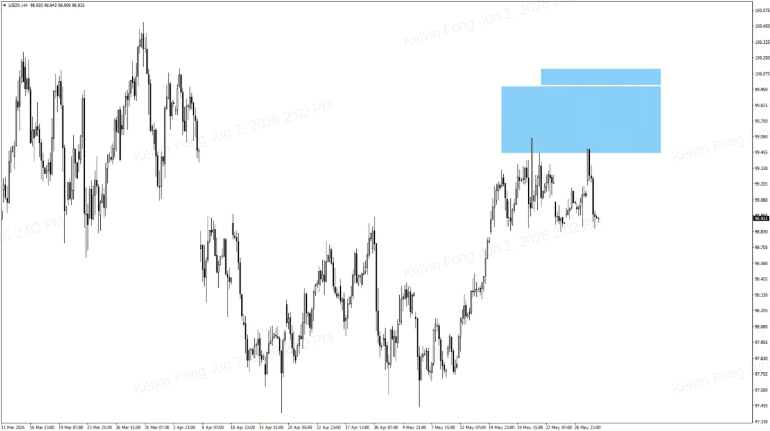
- The dollar index continues to trade within a consolidation structure after briefly rotating lower from the 99.65 monitored area, but price action has yet to confirm a sustained bearish breakdown.
- If price trades lower, the next area of interest sits at 98.40, where buyers may look for reaction and potential stabilization.
- On the upside, a rebound toward 99.85 could attract sellers again if bearish rejection signals appear, keeping the broader structure range-bound until a clearer breakout emerges.
XAUUSD

- Gold traded lower after failing to break above the 4590 resistance level, suggesting upside momentum has weakened in the short term.
- If price attempts a rebound, traders should watch the 4510 area closely for potential reactions and intraday bearish signals.
- Overall, the structure remains range-bound, with market participants still waiting for a clearer directional breakout.
SP500

- A potential peace announcement is providing a tailwind for the S&P 500 Index, supporting risk sentiment as traders’ prices improved geopolitical outlook and reduced downside risk to growth expectations.
USOil
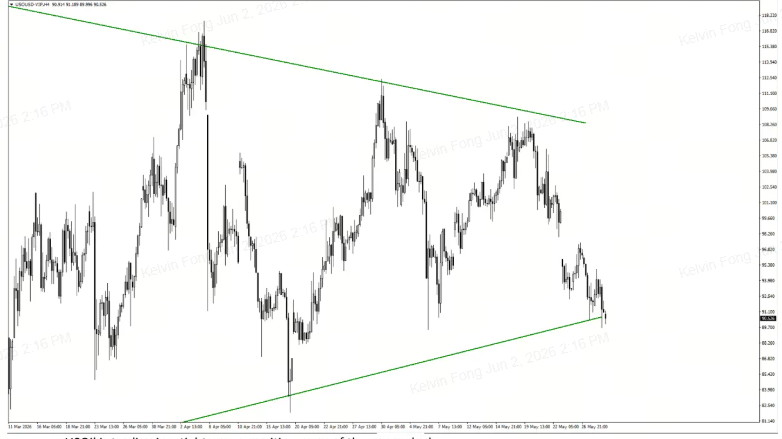
- A successful negotiation outcome would likely weigh on prices, opening the door for downside pressure as geopolitical risk premiums fade.
- Conversely, any breakdown or delay in talks could support a rebound, as traders reprice supply risk and regional uncertainty.
- For now, the market remains event-driven, with traders positioned for volatility once clarity emerges from the negotiation outcome.
BTCUSD
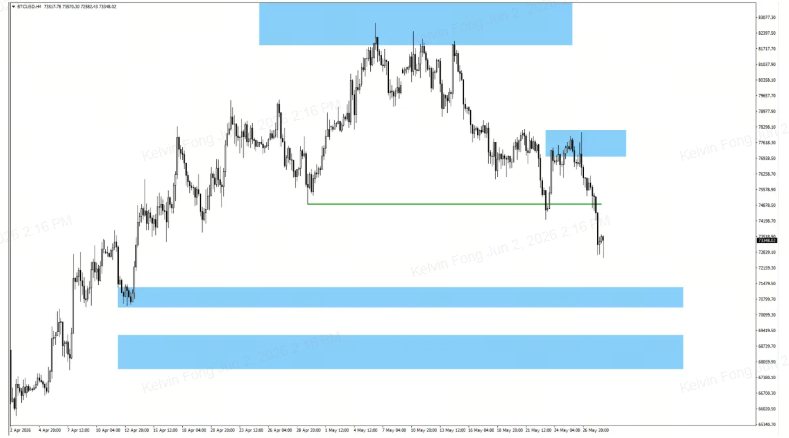
- Bitcoin traded lower after breaking down from the 77200 monitored area, suggesting short-term momentum has shifted to the downside.
- If price continues to consolidate below the breakdown level, the next downside target to watch is 71325, where traders may look for potential reaction or stabilization.
Bottom Line
The AI story remains one of the strongest drivers of global equity sentiment, and OpenAI has become its most visible symbol.
A successful IPO would likely strengthen confidence in the long-term AI growth narrative and provide support for technology-heavy indices such as the Nasdaq.
However, investors are increasingly being asked to balance extraordinary growth expectations against unprecedented capital requirements.
For now, optimism continues to dominate. The question facing markets is whether future earnings growth can continue to justify valuations as funding needs, competition, and infrastructure costs continue to rise.
That debate may become one of the defining themes for technology markets in the months ahead.
Create a live VT Markets account today to access our platform features, including market insights and educational content.
Trader Questions
Why is the expected OpenAI listing considered a major test for the market?
It serves as a critical referendum on the broader artificial intelligence trade, meaning a successful debut would validate the heavy valuations driving the tech sector, while a poor showing could cool overall investor risk appetite.
What is the main argument dividing supporters and skeptics regarding its valuation?
Supporters believe OpenAI will become the foundational infrastructure layer of the future digital economy, whereas skeptics argue that even rapid revenue growth cannot justify the staggering capital expenditures required to run and build these advanced models.
Which sectors are most sensitive to OpenAI’s market performance?
The immediate impact will felt across Nasdaq-linked equities, semiconductor manufacturers, cloud infrastructure providers, and data center operators, all of whose growth stories are deeply intertwined with OpenAI’s infrastructure spending.
What major risk could shift investor sentiment during public listing?
A sudden tightening of financing conditions or rising interest rates could force institutional investors to shift their focus away from raw growth potential and demand immediate, sustainable profitability.
How does competition for capital affect high-growth tech shares?
Because massive initial public offerings absorb large amounts of institutional liquidity, a crowded market with multiple tech and aerospace firms seeking funding will force investors to become much more selective on valuations.
Start trading now – Click here to create your real VT Markets account