


Key Points
- Gold slipped to around $5,130 per ounce on Tuesday as President Trump suggested the Middle East conflict could end soon.
- XAUUSD trades at 5160.52, up +23.11 (+0.45%), with MA5 5139.01, MA10 5174.21, MA20 5105.75, MA30 5073.06.
- Markets now fixate on US inflation data with CPI on Wednesday and PCE on Friday, which can reshape Fed rate-cut pricing.
Gold slipped to around $5,130 per ounce on Tuesday, extending losses from the previous session, after President Trump signalled the Middle East conflict could end soon. Recent comments from the US President helped temper fear in broader commodity markets, which reduced the urgency to hold bullion purely for protection.
Gold often rises hardest when markets fear a long disruption. When leaders hint at a shorter timeline, traders tend to take profit fast, especially if the US dollar stays firm and yields do not fall.
If headlines keep leaning toward de-escalation, gold may struggle to regain momentum and could keep rotating around the $5,130 area. If markets lose confidence in the “ending soon” narrative, bullion can regain support quickly because positioning has already lightened.
Higher Inflation Risk Still Limits Rate-Cut Hopes
Even as war-end talk cools, safe-haven demand, the inflation channel remains active. Traders have scaled back expectations for Federal Reserve rate cuts this year because higher energy prices can feed into inflation and keep policy tighter for longer. Our research desk has linked recent gold weakness to a stronger dollar and reduced optimism on near-term easing.
This matters for gold because higher real yields raise the opportunity cost of holding a non-yielding asset. In this tape, gold can lose its “pure haven” role and start trading like a rates product.
If inflation expectations rise faster than growth worries, yields can stay sticky and gold may remain capped even during risk-off sessions. If growth fears rise and yields roll over, gold can recover even if geopolitics calms.
US CPI and PCE Can Reset the Fed Narrative
Traders now wait for US inflation data for fresh direction. The Bureau of Labor Statistics schedule shows February 2026 CPI releases on Mar. 11, 2026 at 08:30 AM, which lines up with the market focus on “Wednesday CPI”.
For PCE, the BEA lists the next release as March 13, 2026, matching the “Friday PCE” focus.
If CPI and PCE come in hot, markets can push back expected easing further. If they cool, traders may bring rate cuts forward again, which can weaken the dollar and help gold stabilise.
A stronger CPI or PCE print can pressure gold even if the Middle East risk fades, because rates can take over as the main driver. A softer set of prints can lift gold, but the move may stay choppy if oil remains volatile.
Technical Analysis
Gold (XAUUSD) is trading near 5,160, up roughly 0.45%, as the metal attempts to stabilise following the pullback from the recent high at 5,598.60.
The broader trend remains upward, but price action over the past few sessions suggests the market is entering a consolidation phase after the sharp rally earlier in the year.
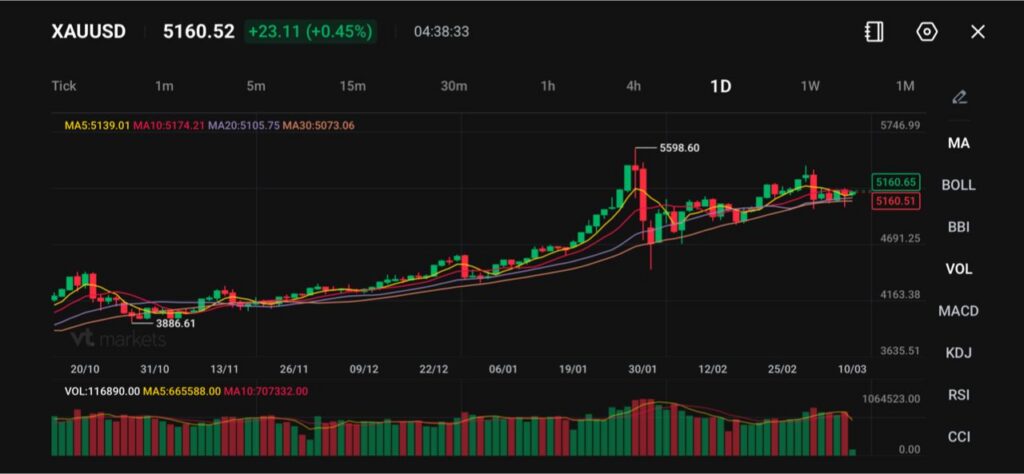
Technically, gold continues to trade above its key moving averages. The 5-day moving average (5,139) and 10-day (5,174) are closely clustered around the current price, indicating a short-term balance between buyers and sellers.
Meanwhile, the 20-day moving average (5,105) and 30-day (5,073) remain below the market and continue to trend upward, reinforcing the longer-term bullish structure.
Immediate resistance is seen around 5,250–5,300, which has capped recent attempts to push higher. A break above this zone could bring the market back toward 5,400, followed by the previous peak near 5,600.
On the downside, initial support lies near 5,100, where the 20-day moving average is positioned, with stronger structural support closer to 5,000.
Overall, gold appears to be consolidating within an upward trend, with the market digesting earlier gains. As long as prices remain above the 5,100 support area, the broader bullish outlook remains intact, while a sustained move above 5,300 could signal a renewed push toward recent highs.
What to Watch Next in One Glance
- Trump’s follow-up messaging after calling the operation a “little excursion” and “short-term”, because that steers the risk premium.
- The US inflation run with CPI on Wednesday and PCE on Friday, because that can swing yields and the dollar.
- Whether XAUUSD holds above MA20 5105.75 and MA30 5073.06, because that defines whether the current dip stays a consolidation or turns into a trend break
Learn more about trading Precious Metals on VT Markets here.
FAQs
- Why Did Gold Slip to Around $5,130 Per Ounce?
Gold slipped to around $5,130 per ounce as traders reduced geopolitical hedges after President Trump suggested the Middle East conflict could end soon. When markets believe war risk may shorten, they often unwind “insurance” positions in gold. - How Can Gold Fall Even When Inflation Risk Still Exists?
Gold can weaken when yields and the US dollar rise. Fears that a prolonged conflict could lift inflation have pushed traders to scale back expectations for Federal Reserve rate cuts. That can keep interest rates higher for longer, which increases the opportunity cost of holding gold. - What Did Trump Say That Moved Market Sentiment?
Trump described the operation as a “little excursion” and a “short-term” endeavour, which eased some geopolitical concerns. That shift in tone can reduce safe-haven demand quickly, even before any real de-escalation occurs. - Is Gold Trading Geopolitics or US Interest Rates Right Now?
Both matter, but the balance can shift day to day. When headlines point to a shorter conflict, gold tends to track rates and the dollar more closely. When escalation headlines return, gold often trades as a direct hedge again. - Why Do CPI and PCE Matter for Gold Prices?
CPI and PCE influence expectations for Federal Reserve policy. If inflation data comes in hot, markets may expect fewer rate cuts, which can push yields up and pressure gold. If inflation data cools, markets can revive rate-cut bets, which can help gold recover. - What Should Traders Watch in CPI and PCE Specifically?
Traders watch the surprise versus expectations and whether inflation pressures look broad-based. A strong print can reinforce the idea that the Fed will keep rates restrictive. A weaker print can support the case for easing and reduce support for the US dollar.
Start trading now – Click here to create your real VT Markets account